

What Is Patient-Centric Healthcare? Why Your Health Information Should Stay Connected
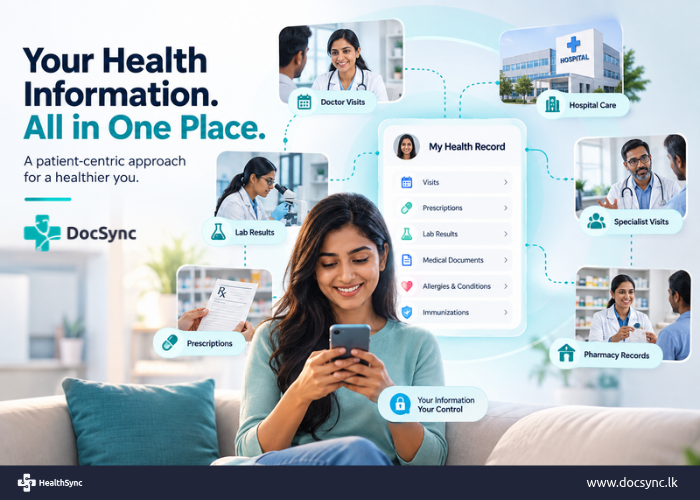
Think about the last few times you needed healthcare.
You may have visited your family doctor, seen a specialist, completed a blood test at a laboratory, collected medicine from a pharmacy, or gone to a hospital.
Now think about where all that information is today.
Your prescription might be in a drawer. Your blood report could be in WhatsApp. An X-ray may be saved on your phone. Your doctor has notes from your last visit. Another hospital may have an entirely different record.
The information belongs to the same patient – but it is often scattered across many different places.
Patient-centric healthcare aims to change that.
So, what does “patient-centric healthcare” actually mean?
Patient-centric healthcare puts you, the patient, at the centre of your healthcare journey.
Instead of thinking about each doctor, hospital, laboratory or pharmacy as a separate experience, your healthcare is viewed as one continuous journey.
Imagine this:
Doctor → Lab → Pharmacy → Specialist → Hospital → Follow-up
These are not six unrelated healthcare events.
They are all part of your health story.
When the right information can move securely with you, healthcare professionals can better understand what happened before and make more informed decisions about what should happen next.
The problem with fragmented healthcare
Imagine you visit a doctor today because you haven’t been feeling well.
The doctor orders some blood tests. You complete them at a laboratory and receive the report.
A few months later, you see another doctor.
That doctor may ask: “Have you done any blood tests recently?”
You know you did. But where is the report?
Maybe it is somewhere in WhatsApp. Perhaps you received a printed copy. Maybe you left it at home. Or you simply cannot remember which laboratory performed the test.
The second doctor may therefore be making decisions without seeing information that could be important.
Now multiply that situation across years of healthcare.
That is the problem patient-centric healthcare tries to solve.
Why keeping your health information together matters
1. Your next doctor can understand your story
A doctor should ideally be able to understand more than what is happening today.
Previous conditions, allergies, medicines, investigations and treatments can all provide important context.
When your health information is organized over time, you can give healthcare professionals a much clearer picture of your history.
Instead of trying to remember: “I think I took a tablet for this about two years ago…”
you have information you can refer back to.
2. You don’t have to start from zero every time
Changing doctors shouldn’t mean restarting your medical history.
Moving to another city shouldn’t mean losing years of health information.
Seeing a specialist shouldn’t require searching through cupboards for old reports.
Your healthcare journey continues even when the healthcare provider changes.
That is one of the most important ideas behind patient-centric care:
Your healthcare history should follow you.
3. It makes long-term care easier
Connected information becomes particularly valuable for people living with long-term conditions such as diabetes, hypertension, thyroid conditions or heart disease.
One blood pressure reading tells a doctor something.
A history of blood pressure readings tells them much more.
The same applies to blood sugar, cholesterol, thyroid results, medications and many other aspects of healthcare.
Over time, individual records begin to form a much more useful picture.
4. You become an active participant in your healthcare
Traditionally, medical information has often remained with the healthcare provider.
Patient-centric healthcare changes that relationship.
Patients should be able to understand what information exists about their health and keep track of important records themselves.
That doesn’t mean patients replace doctors or interpret everything independently.
It means they become better informed participants in their own care.
What could a connected healthcare journey look like?
Imagine visiting a doctor who uses DocSync.
Your doctor records the consultation, creates your prescription and plans a follow-up.
Instead of that information remaining only inside the clinic, relevant information can also become available through your HealthSync profile.
Later, you may upload a laboratory report to the same personal health record.
When you need to see another healthcare professional, you have your health information available rather than trying to reconstruct your medical history from memory.
Over time, your health profile can become a useful timeline of your healthcare journey.
Different healthcare experiences. One patient. One connected story.
But shouldn’t every doctor simply see everything?
Not necessarily.
Patient-centric healthcare does not mean giving every healthcare provider unrestricted access to all of your medical information.
Healthcare information is deeply personal.
Connected healthcare therefore needs to be built around privacy, security and patient consent.
The goal is to make information available when it is genuinely needed for your care, while maintaining appropriate controls over who can access it.
Convenience should never come at the expense of patient privacy.
Where DocSync and HealthSync fit
Our vision is simple.
DocSync helps healthcare professionals deliver and document care.
HealthSync helps patients maintain their personal health information.
Together, they are designed to help bridge one of the biggest gaps in healthcare: the disconnect between the care provided by healthcare professionals and the health information available to the patient afterwards.
The objective isn’t simply to replace paper with a screen.
It is to help create a healthcare experience where information can remain connected throughout the patient’s journey.
One patient. One healthcare journey.
Healthcare will always involve different people.
You may see your family doctor today, a specialist next month and visit a hospital years from now.
Those healthcare providers may change.
But the patient remains the same.
That’s why the future of healthcare shouldn’t revolve entirely around individual institutions or individual systems.
It should revolve around the patient.
Because when patients can keep their health information organized, accessible and connected, they are better prepared for every step of their healthcare journey.
Your health information is part of your story. It shouldn’t disappear every time you walk out of a consultation room.