

DocSync and Sri Lanka’s National EHR – Building for a Connected Future
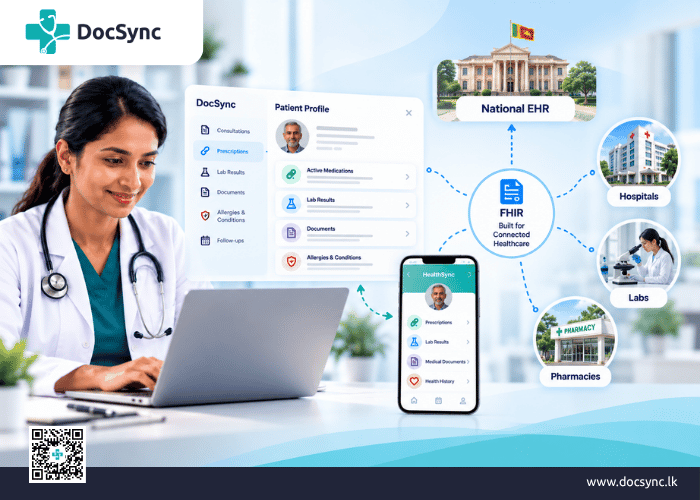
Built for Sri Lanka. Ready for Connected Healthcare: How DocSync Aligns With National eHealth Standards
Why choosing the right Electronic Medical Record (EMR) system today matters for the future of your practice and your patients.
Imagine a patient visiting a private doctor in Colombo for diabetes management.
A few months later, the same patient visits a specialist in Kandy. Later, they are admitted to a hospital in another district.
Each healthcare provider may use a different system. Their prescriptions, diagnoses, laboratory reports, and consultation histories may be stored in completely separate places.
The patient remains the same. But their medical information doesn’t always follow them.
This is one of the biggest challenges facing digital healthcare in Sri Lanka – and it’s exactly why interoperability matters.
At DocSync, we believe an EMR should do more than help doctors write prescriptions, record consultations, and generate bills.
It should also be built for a future where healthcare information can move securely between authorized healthcare providers.
That’s why DocSync has been developed from the ground up with international interoperability standards such as HL7 FHIR in mind, guided by Sri Lanka’s National eHealth Guidelines and Standards.
Sri Lanka Already Has a Vision for Connected Healthcare
Many doctors may not be aware that Sri Lanka’s Ministry of Health has established national guidelines for the development and adoption of digital healthcare systems.
The National Digital Health Guidelines and Standards (NDHGS) provide a framework for creating a more coordinated, secure, and interoperable healthcare environment.
Rather than allowing every hospital, clinic, and software provider to develop completely disconnected systems, the guidelines establish a common direction for how healthcare information should be managed and exchanged.
The Ministry of Health’s Digital Health Blueprint also recognizes the importance of interoperability, national health information exchange, and lifelong electronic health records.
This is an important development for Sri Lankan healthcare.
Because digital transformation shouldn’t simply mean replacing paper files with computers.
It should mean making healthcare information more useful, accessible, secure, and connected throughout a patient’s life.
What Is Sri Lanka’s National Electronic Health Record (NEHR)?
One of the most significant components of Sri Lanka’s national digital health vision is the National Electronic Health Record (NEHR).
Instead of a patient’s medical history existing only within individual hospitals or clinics, a national electronic health record would support an authorized, longitudinal view of relevant healthcare information.
For example, imagine a patient who has been receiving treatment for hypertension at a private clinic.
If that patient later requires hospital treatment, relevant information from previous consultations could potentially help the treating team understand their medical history, medications, and ongoing conditions.
The Ministry of Health’s guidelines specifically envisage APIs that allow approved EMR systems to communicate with the NEHR, using a national HL7 FHIR profile.
This doesn’t mean every doctor or healthcare institution will automatically have access to every patient’s information. Identity verification, authorization, privacy, and security remain essential requirements.
But it establishes an important direction for the future.
Healthcare information should be able to support the patient across different healthcare settings — not remain trapped inside individual software systems.
What Is FHIR, and Why Should Doctors Care?
FHIR stands for Fast Healthcare Interoperability Resources.
Developed by Health Level Seven International (HL7), FHIR is an internationally recognized standard for exchanging healthcare information electronically.
The technical details can become complicated, but the idea is simple.
Think about how you can send an email from Gmail to someone using Outlook. Both services are different, but they can communicate using common standards.
Healthcare systems need something similar.
A hospital may use one Health Information System (HIS), a private clinic may use another EMR, and a laboratory may use its own reporting platform.
FHIR provides a standardized way for these systems to represent and exchange healthcare information.
That can include patient demographics, conditions, allergies, medications, observations, and other clinical records.
For doctors, the potential benefits are significant.
Instead of depending entirely on patients carrying printed records between healthcare providers, appropriately connected systems could make relevant information available through secure, authorized exchanges.
FHIR isn’t just a technical feature. It’s part of the foundation for better continuity of care.
Why We Built DocSync With Interoperability in Mind From Day One
Not all EMR systems are designed with the same long-term objectives.
Some systems primarily focus on immediate clinic operations: registering patients, printing prescriptions, generating bills, and storing consultation notes.
These functions are important. In fact, they’re essential for running an efficient private practice.
But there’s a bigger question doctors should consider when selecting an EMR:
What happens to my patients’ medical information when healthcare systems become more connected?
A system designed only to store information in its own database may require significant additional development to support standardized healthcare data exchange.
DocSync takes a different approach.
We’ve designed DocSync from the beginning with international healthcare interoperability standards, including FHIR, in mind.
Our objective is to support modern clinical workflows today while creating the technical foundation for future integrations with hospitals, laboratories, other EMR platforms, and national healthcare infrastructure.
This doesn’t mean every external integration is already available. Each connection requires compatible systems, appropriate technical implementation, security controls, and authorization.
But by making interoperability a core architectural consideration rather than an afterthought, we’re building DocSync for the healthcare environment Sri Lanka is working toward.
What about integration with Sri Lanka’s National EHR?
DocSync’s FHIR-oriented architecture is intended to support future integration with Sri Lanka’s National Electronic Health Record.
When the relevant national interfaces, implementation requirements, and onboarding arrangements are available, our goal is to work toward the necessary technical conformance and Ministry of Health approvals.
This is an important distinction: being designed for integration is not the same as already being connected or officially approved.
Our commitment is to prepare DocSync for that future while continuing to follow applicable national requirements as they evolve.
Patient Privacy Must Come First
Connected healthcare creates enormous opportunities, but it also introduces responsibilities.
Medical records contain some of the most sensitive information about a person.
Diagnoses, prescriptions, laboratory findings, and personal medical histories should never be accessible simply because someone has access to a clinic computer.
That’s why privacy and security are central to DocSync’s design.
Rather than depending on an unprotected patient database stored on a local clinic computer, DocSync uses a centrally managed approach to healthcare information.
Its workflows are designed around controlled access, patient authorization, and accountability.
For example, DocSync incorporates patient OTP verification when accessing medical profiles, with a documented exception process for circumstances where OTP verification cannot be completed.
These mechanisms are intended to support responsible access to patient information while accommodating real-world clinical situations.
Sri Lanka’s Personal Data Protection Act (PDPA) also makes data protection an important consideration for organizations handling personal information.
Our approach is to build privacy and security into DocSync’s architecture and operational workflows, rather than treating them as optional features.
Of course, responsible data protection also depends on secure operations, appropriate staff practices, and ongoing compliance — not software design alone.
DocSync and HealthSync: Connecting Doctors and Patients
One of the most important parts of our vision is the relationship between DocSync and HealthSync.
Traditionally, medical information has often remained within the healthcare institution where it was created.
A patient visits a doctor, receives a prescription, and leaves with a printed document.
The clinic keeps its own records, while the patient is responsible for maintaining everything else.
But what if the patient could also maintain a connected personal health history?
That’s where HealthSync comes in.
DocSync is designed for doctors to manage clinical care, while HealthSync provides patients with a personal health record.
Through this connected ecosystem, relevant consultation information can become available in the patient’s HealthSync profile, helping them organize their medical history beyond a single clinic visit.
Patients can maintain information such as prescriptions, laboratory reports, medical documents, and other health records in one place.
HealthSync is free for patients to get started.
This creates an important benefit for both doctors and patients.
Doctors can maintain organized clinical documentation, while patients have a way to keep track of their healthcare journey.
The goal is simple: a patient’s medical history shouldn’t start over every time they visit a different doctor.
Why DocSync Is a Different Kind of EMR for Sri Lanka
When evaluating EMR software in Sri Lanka, doctors should look beyond the number of features or how quickly a prescription can be printed.
They should also ask:
- Will this system help me manage my practice efficiently?
- Can I securely access and maintain my patients’ clinical histories?
- Does it support continuity of care beyond individual visits?
- Has it been designed with recognized healthcare interoperability standards in mind?
- Can it evolve alongside Sri Lanka’s national digital health infrastructure?
These are the questions that have shaped DocSync.
Our approach brings together three important priorities: simple clinical workflows, patient-centered continuity of care, and standards-oriented architecture.
We believe this combination makes DocSync a compelling choice for Sri Lankan doctors who want more than basic clinic management software.
Rather than making an unsupported claim that one product is objectively better than every alternative, we encourage doctors to evaluate these capabilities when comparing EMR solutions.
A modern EMR should make today’s consultations easier without limiting tomorrow’s possibilities.
The Future of Healthcare in Sri Lanka Is Connected
Sri Lanka’s healthcare system includes public hospitals, private hospitals, independent practitioners, specialists, laboratories, pharmacies, and many other providers.
Each plays an important role in caring for patients.
But the true potential of digital healthcare will emerge when these different parts of the system can work together more effectively.
The Ministry of Health’s National Digital Health Guidelines and Standards provide an important foundation for this direction.
At DocSync, we’re building with that future in mind.
We’re not simply developing software to replace handwritten prescriptions or paper-based patient files.
We’re building an EMR platform designed to help Sri Lankan doctors deliver efficient, secure, and connected healthcare — today and into the future.
Because the future of healthcare isn’t just digital.
It’s connected.
Discover DocSync
Are you starting a private practice or looking to modernize an existing clinic?
Discover how DocSync brings prescriptions, clinical documentation, billing, patient management, and continuity of care together in one platform.
Explore DocSync: https://docsync.lk/